
The Team Lactate Threshold
What sports science taught me about growth, stress, adaptation, and why not all organizational friction is dysfunction.

During a management training session at work recently, we spent time discussing a familiar leadership challenge: how do you help teams grow without pushing them into burnout?
As the conversation unfolded, my mind wandered somewhere unexpected: Sports!
This isn’t unusual.
Having spent much of my life both as an athlete and as a leader of engineering teams, I’ve often been surprised by how similar the challenges are. In fact, over the years, I’ve probably learned more about leadership from sports than from many management books, frameworks, or training courses combined.
Sports have a way of exposing fundamental truths about human performance. They make visible the relationship between stress and adaptation, effort and recovery, challenge and growth. The same dynamics exist in organizations, but they’re often harder to recognize because they play out over months instead of minutes.
Let’s not derail though! One idea from sports physiology kept coming back to me throughout that management discussion: lactate😬.
Most of us learned to think of lactate as the thing that makes muscles burn and performance deteriorate. As it turns out, modern science tells a very different story❗️
The more I learned about it, the more it felt like a useful lens for understanding teams, leadership, and the difference between growth and survival mode.
The Story We Were Told
For decades, athletes were taught that lactate was the enemy.
It was blamed for many things: fatigue, the burning sensation in muscles, and ultimately declining performance.
The story was simple:
work harder → produce lactate → suffer
Like many simple stories, it was appealing, but like many appealing stories, it wasn’t entirely true.
Modern sports science has fundamentally changed how we understand lactate. Researchers now know that lactate is not simply a waste product generated when the body starts struggling. It is also a fuel source, continuously produced and reused throughout the body by muscles, the heart, the liver, and even the brain.
More importantly, lactate is closely linked to adaptation. Its presence doesn’t necessarily indicate that the body is failing. In many cases, it simply indicates that the system is operating near the limits of its current capacity.
That distinction matters‼️
Because once you understand it, it becomes difficult not to notice the same pattern in organizations.
The Myth of the Comfortable Team ❔
Many leaders unconsciously optimize for comfort. We naturally gravitate toward smooth delivery, predictable outcomes, stable processes, and environments where conflict is rare and surprises are even rarer.
At first glance, that sounds entirely reasonable. After all, nobody wants chaos. The problem is that comfort and growth rarely coexist for very long.
A runner sitting on the couch experiences very little physiological stress. Their lactate levels remain low, nothing hurts, and nothing appears to be going wrong. But nothing improves either.
Teams are no different.
A team operating entirely within its current capabilities may look efficient on the surface while gradually becoming less adaptable. Without meaningful challenge, there is little reason to develop new capabilities, rethink assumptions, or discover better ways of working.
Growth begins when we ask the system to do something it cannot yet do comfortably. It might be entering a new market, undertaking a complex migration, pursuing an ambitious product vision, navigating organizational change, or dealing with the challenges that accompany rapid growth.
Whatever the trigger, increasing demand tends to reveal things that were previously hidden. And the organizational equivalent of lactate starts to appear.
Organizational Lactate
You’ve probably seen it before.
Hidden dependencies begin to emerge, architectural weaknesses become visible, decision-making often slows down, and communication bottlenecks start appearing. Challenges that remained invisible while the team operated comfortably suddenly become impossible to ignore.
Many managers interpret these signals as evidence that something is broken.
Sometimes they’re right. More often, however, they are simply observing a system operating at a higher intensity than before. The team is discovering its limits in much the same way an athlete discovers theirs during a difficult training session.
Seen through that lens, friction is not necessarily a sign of dysfunction. In many cases, it is the first indication that adaptation has begun.
» The real question is not whether stress exists.
» The real question is whether the system can process it.
The Team Lactate Threshold📈
Sports scientists often talk about something called the lactate threshold.
Put simply, it represents the point at which exercise intensity becomes high enough that lactate accumulates faster than the body can comfortably process and reuse it. Below that threshold, effort is generally sustainable. Above it, fatigue begins to accumulate more rapidly, and performance eventually declines.
Importantly, athletes do not train to avoid this threshold. They train to move it‼️
An experienced athlete can sustain levels of effort that would completely overwhelm a beginner, not because they experience less stress, but because they have developed a greater capacity to adapt to it.
The same principle applies to organizations.
The goal is not to eliminate pressure. The goal is to build a system that can handle more pressure without breaking.
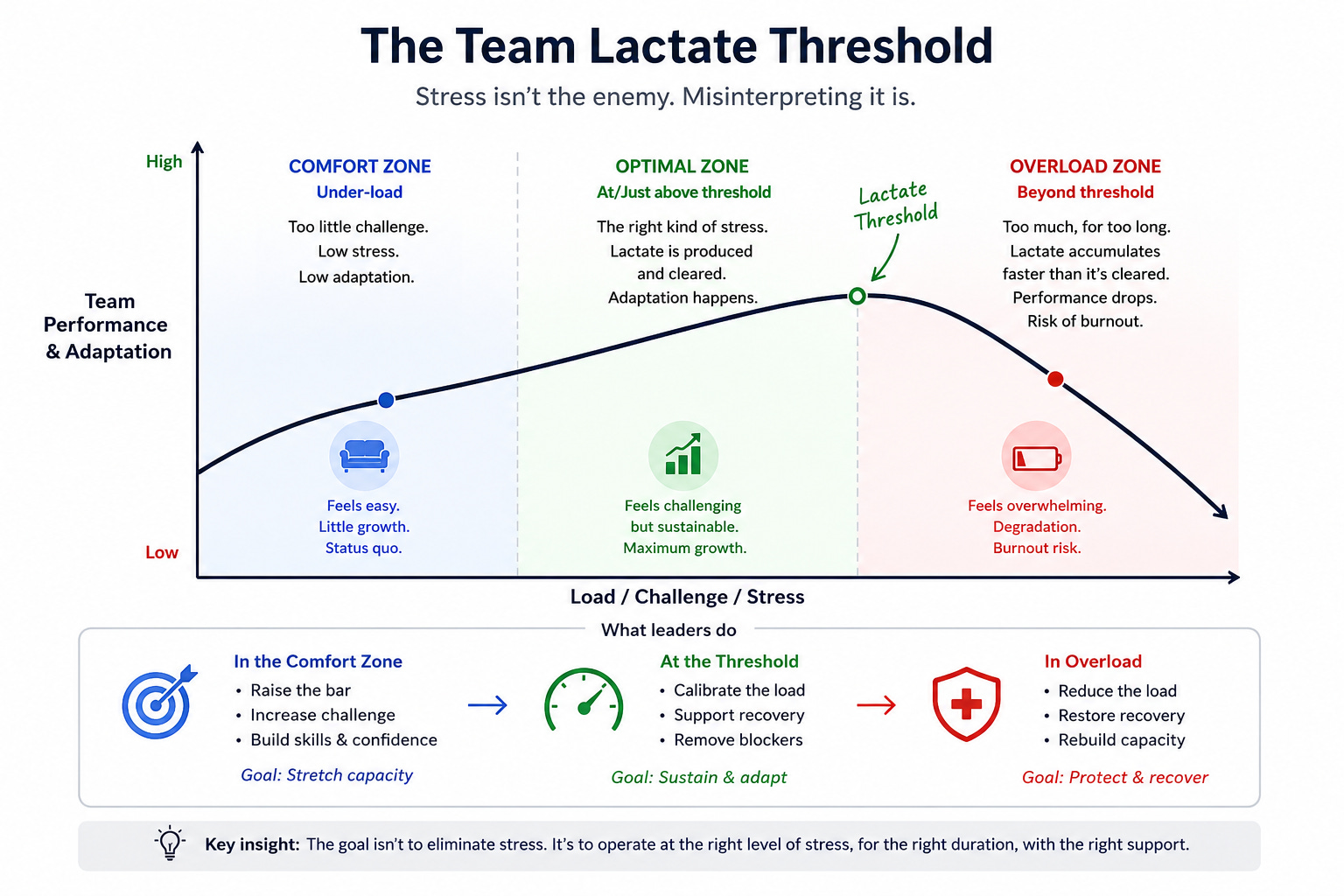
I find it useful to think about teams as operating across five distinct zones.
The Team Lactate Threshold Model
The key insight is that growth does not happen in comfort. But neither does it happen in burnout. It happens somewhere in between.
The Mistake Organizations Keep Making
Many organizations understand that challenge creates growth. They then make a dangerous leap in logic: if some pressure is good, more pressure must be better.
Athletes know this isn’t true.
Training only works because stress is followed by recovery. Without recovery, adaptation never occurs. Instead, performance gradually deteriorates despite increasing effort. Sports science refers to this as overtraining.
Organizations experience the same phenomenon.
Every quarter becomes critical. Every initiative becomes urgent. Every roadmap becomes aggressive. Teams are expected to continuously deliver at their maximum capacity while simultaneously adapting to change.
Initially, the additional pressure produces results. Output increases, deadlines are met, and the organization appears to be operating at a higher level. Eventually, though, the cracks begin to show. Quality declines, innovation slows, and turnover rises as accumulated stress outpaces the system’s ability to recover.
This is the moment many organizations mistake survival mode for high performance. The difference between the two is surprisingly simple:
High-performing systems recover and adapt, while survival-mode systems merely endure!
The Lactate Shuttle
Perhaps the most fascinating discovery in modern physiology is the concept of the lactate shuttle.
Scientists discovered that lactate is not simply produced and discarded. One part of the body produces it, while another consumes it. What appears to be waste is actually being reused as fuel elsewhere in the system.
The best organizations behave similarly;
They don’t eliminate tension; they metabolize it.
Incidents become learning opportunities. Failures become system improvements. Disagreements become better decisions. Pressure becomes capability.
Less mature organizations treat stress as waste.High-performing organizations convert stress into learning.
The organizational equivalent of the lactate shuttle is feedback‼️
A Question for Leaders
Most managers instinctively ask how they can reduce stress on their teams. While that concern is understandable, it may not always be the most useful question.
A better question might be whether the stress a team is experiencing is creating adaptation or simply creating accumulation.
Not all stress is equal. Some forms of stress expand capability, strengthen resilience, and help teams develop new ways of operating. Other forms gradually erode capacity, increase fragility, and consume energy without producing meaningful growth.
The challenge of leadership is not to eliminate stress altogether. It is to distinguish between the kinds of stress that help a team grow and the kinds that slowly wear it down.
Final Thought
The traditional view of lactate was appealing because it was simple. If muscles burned and performance declined, then lactate must be the culprit.
The science turned out to be considerably more interesting.
Today, lactate is understood not as the enemy of performance, but as part of the mechanism that makes higher levels of performance possible. It is a signal that the body is operating under increased demand, and a participant in the process that allows the body to adapt to that demand over time.
The same may be true of organizational friction.
Not every bottleneck is a failure, every disagreement a sign of dysfunction, or every period of discomfort evidence that something is wrong. Sometimes these are simply the signals that appear when a team is stretching beyond its current capabilities and beginning to adapt.
The goal of leadership is therefore not to eliminate organizational stress. The goal is to build teams that can respond to stress, recover from it, and ultimately grow because of it.
Or, to borrow a lesson from sports science:
The objective isn’t to avoid the threshold. It’s to gradually move it‼️